Book Review and Summary of Pablo Escobar: My Father
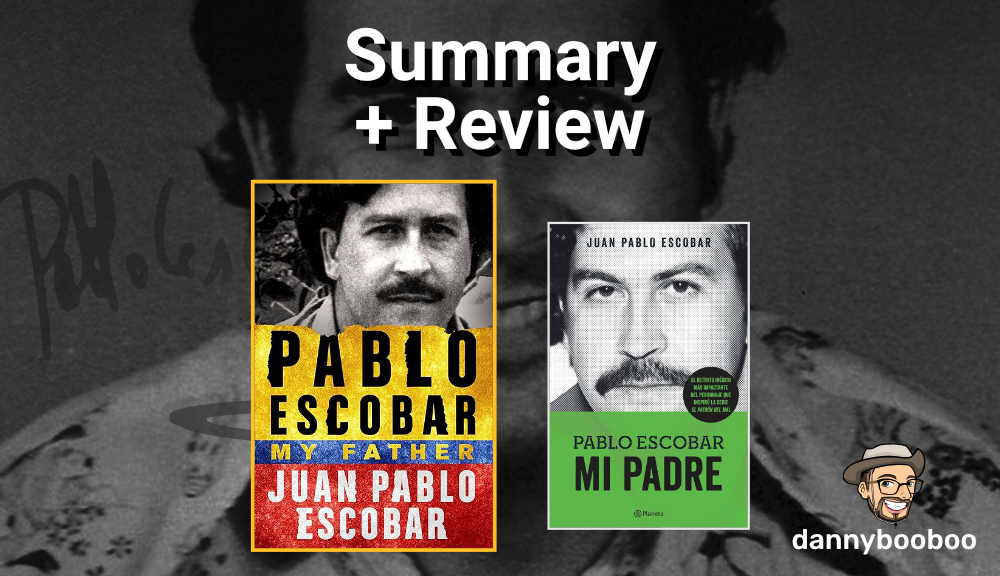
TABLE OF CONTENTS
Welcome to my Pablo Escobar: My Father book summary!
“Who is more of a bandit? Me who choose it or those who, taking advantage of the cloak of authority, outrage my children and innocent wife with their police uniform?” (p. 282)
One-Sentence-Summary: Published 20 years after Pablo Escobar’s death in 1993, who had an estimated $3-25 billion ($11-94B today), his only son, Juan Pablo Escobar, writes a intently-neutral book detailing his father’s life.
My review, summary, and commentary of Pablo Escobar: My Father will not be neutral. I welcome your perspective in the comments.
booboo real-time book rating: ★★★★★ (percentage of books with this rating: 7%)
Extradition
In his 1990 presidential bid, “Galán returned to the topic of extradition and maintained that it was the only efficient tool to combat narcotrafficking.” (p. 298)
Colombia has legal extradition with the USA, yet the demand for cocaine has consistently risen since the 1980s; as well as the supply. Ultimately, what did the pursuit of Pablo accomplish? Might there have been an ulterior motive? Pablo’s red line was extradition, as it was for many members of the Medellin Cartel.
Politicians kept pushing, and I must credit them for their resolve in the face of numerous deaths. I don’t give them any credit in the war against drugs because they were not fighting that war, though they’d convince you they were in public. If they were fighting the drug trade, they’d fantastically failed. They were playing the game for power, and the politicians won.
In July 1990, shortly after the new Colombian president, César Gaviria, took office, Pablo said in a letter to his son in Europe at the time, “I have decided to change strategies, and the war stops with the new government. Since the president-elect has said that extradition is not an obligation and everything depends on the public order and so the public order will be good.”
It was simply all about extradition. He simply did not want to be extradited. I won’t give my personal opinion on this besides saying what I’ve already said: what was the point of pursuing Pablo if his only evil actions in Colombia were in retaliation to the extradition?
I think one of Pablo’s most significant errors was not being extraordinarily clear with the public, his team, and his family about what he would do and why he was doing it in the face of extradition.
Pablo became known more and more as a terrorist in his country in his final days, and my guess is that some of his most loyal followers started to detract as he was killing the innocent. He did kill innocent people, and many don’t forgive him for that. Neither do I.
But I equally don’t forgive the government for killing and ruining the lives of exponentially more innocent people in a longer time frame. So I ask you, what’s worse: a man selling cocaine in another country or a government failing consistently for 30 years with 70% of the population living in poverty?

You are reading my Pablo Escobar book summary. Please enjoy.
Is Pablo Worse Than the Government?
Pablo Escobar broke the law by selling an illegal drug, as defined by the government. This does nothing to deter demand, the core issue. Cigarettes, alcohol, and pharmaceuticals (ie legal and regulated and taxed) exist and are just as bad as cocaine.
Everyone has the potential to commit a crime. However that potential is limited by the resources of the individual. A homeless person on the street can kill one person before being apprehended. A normal citizen can kill dozens of people with a gun. A terrorist (though I’ll admit that adjective is hard to define) organization can plan an event to kill hundreds or thousands. Government can and has killed millions.
What I want you to recognize is that just as a homeless person on the street has the potential for evil, so does the government. The only difference is that the government has more resources to enact more evil. Don’t kid yourself that the government is some omnipotent and benevolent organization. It has the potential to commit evil but with the “law” and the narrative in its control. And I believe that power is used for evil just as much, if not more, than for good.
I have a problem attributing actions of the government as ‘good’ or, at least, pure intentioned by default. The government killed Iván Marino Ospina in his house and the author’s uncle and Pablo’s best friend, Mario (there was no investigation, and he was not charged with a crime).
Equally, I have a problem attributing the actions of the bandits doing illegal things (as defined by the government) as ‘bad,’ like when they killed Rodrigo Lara Bonilla. Everything has two valid and reasonable sides to the story, as we are learning with the Israel/Gaza/Hamas war.
The Pablo Escobar End Game
Pablo did bad things! He did. But why, when the government does bad things multiplied exponentially, do we not consider it so bad? For one, language and narrative, but that’s a topic for another post.
The pursuit and death of Pablo was not about drugs. It was about power. Ask yourself: what changed since 1993? Did the drug trade reduce? No. It increased. Did the government gain power? Yes. Pablo had too much power. Unfortunately, he didn’t understand that the most powerful are not in politics. They control from behind the scenes. Pablo made a mistake in entering politics. At least it was too soon. I think he would agree, as this is when his life took a turn for the worse.
It irks me to read how his wife could “pardon him for all that he did” (p. 111). In totality, Pablo contributed a fraction of the evil perpetrated in this world compared to governments. Just because the government (yes, your government, too) hides the evil they do in this world doesn’t mean it’s not there. I believe Pablo’s net contribution was positive. He was a good man who had, like all of us, a limit.
A History of Pablo Escobar’s Life
- 1949 – Pablo is born on December 2nd
- 1964 – Aged 15, he counterfeited diplomas for a local school (his first delinquency).
- 1968 – Pablo declares to his friends that he will commit suicide if he does not have 1 million pesos by the age of 30.
- 1971 – Pablo, 24, meets his future wife, Victoria, then 13, in Envigado, just south of Medellin.
- 1974 – Pablo goes to jail for the first time and meets Alberto Preito, a powerful contraband leader connected to the elites and politicians.
- 1975 – Pablo discovers and, quickly, starts selling cocaine.
- 1976 – Pablo asks Victoria to marry him after her mom, Nora, wouldn’t allow her to say goodbye to him before a months-long trip. Victoria “immediately said yes, without a moment of doubt.” (p. 117)
- 1976 – The famous mugshot photo of Pablo Escober was his first time incarcerated for drug trafficking and bribery and there he learned that his wife was pregnant with his first-born, the author of this book, Juan Pablo Escobar.

- 1982 – Elected as a Congressman of Colombia, starting his political career, one that is more corrupt and dangerous than the drug trade, which, ultimately, took his life.
- 1984 –
- April – Pablo’s sicarios killed Rodrigo Lara Bonilla, an important government figure, for betraying Pablo, as he was considered a friend, but helped to remove him from Congress. In response, Colombia approved the extradition of Pablo to the USA. This promoted Pablo to go into hiding first in Panama then in Nicaragua.
- May – Manuela Escobar was born.
- June – Barry Seal, one of Pablo’s pilots smuggling drugs into the USA and working as an informal for the DEA at that time, took and shared photos with the DEA of Pablo at the first shipment of cocaine from Nicaragua. Because of this Pablo had to leave Nicaragua. Seal was murdered 2 years later.
- July – Based on Seal’s photos, a warrant was issued from a Florida judge to arrest Pablo Escober for smuggling drugs into the USA.
- September – Pablo’s father, Abel, was kidnapped in Medellin and held ransom for $10 million. Pablo negotiated to 30,000 COP ($8,000 in today’s money)
- 1985 – M19 took over and burned the Palace of Justice resulting in half the court justices dead. I believe this was in retaliation to the death of their leader. Part of this burning made extradition impossible.
- 1986 – The extradition treaty signed in 1979 was deemed invalid by the Colombian Supreme Court due to it not being signed by the then President. However, soon afterward, it was made legal again.
- 1987 – Carlos Lehder is first to be extradited to the USA and sentenced to life impression plus 135 years (he has been free since 2020), but not before the police offered to release him for 500,000 pesos. Pablo accepted, but Lehder denied. Later this year, the extradition was repealed in Colombia.
- 1988 – Mario, Pablo’s best friend, and the author’s uncle was murdered by the government. There was no trial.
- 1989 – The ‘Mexican’, one of Pablo’s closest friends, was murdered by the government. No trial.
- 1990 – Hundreds of police were killed as Pablo issued bonuses based on the officers’ rank. ‘Pinina’ was also killed this year, which was the beginning of the end of the Medellin Cartel given his importance. During this time period, there were also numerous attacks, including the Oporto Bar Massacre, attributed to Pablo which the book refuses as not ordered by him. Makes you wonder if the government did that to better control the narrative..
- 1991 – Pablo submitted himself to La Catedral, the prison he constructed himself, after meeting with priest Rafael García Herreros.
- 1992 – Pablo killed “Kiko” Moncada, one of his best friends, which sent the military to La Catedral to transfer Pablo to another prison, but Pablo escaped from one of his pre-built options.
- 1993 – The year it all fell apart. Los Pepes dealt the final blows killing anyone related including his lawyer, the manager of Hacienda Napoles, and Pablo’s brother-in-law who never wanted anything to do with Pablo and always stayed away, leaving Pablo and his family on their own and hiding with no one on the outside.
- 1994 – The remaining Escobar family, after getting denied entry to dozens of first-world, forward-thinking countries, eventually go to Mozambique, but after four days leaves for Buenos Aires.
Pablo’s Complex Personality of Kindness
“..in a pare of Christmas celebrations, not one nearby town was without gifts for the children.” (p. 141)
In 1986, after the Palace of Justice incident, a volcano erupted in Colombia. Pablo is being actively pursued by the government. Even so, he lent two of his helicopters to help rescue victims of the volcano and bring supplies. He also paused the transport of cocaine for two weeks.
In the next paragraph, the author, Pablo’s son, says, “However, my father had violently demonstrated that he had no problem erasing with his elbows what he did with his hands [a Colombian phrase].” (p. 270)
I’m not here to argue that Pablo is a saint. He is not. Neither are you, likely. I am not, either. Most definitely, neither is the government. You wouldn’t murder, right? But if it would save your family, would you murder? Your country? If it would save all of humanity? You have your limits, just as I do, just as everyone does.
Pablo did bad stuff, along with good stuff. Isn’t that true for everyone? He did that on a larger scale, in both directions. Maybe everybody doesn’t have two helicopters to lend, the resources to build an entire neighborhood, or the ability to send hundreds of kilos of cocaine to the USA (which still exists). This is what blows my mind. Cocaine still exists. It still flows into the USA and at larger scales. So, what exactly did all of this accomplish?
“..one time, four of his helicopters left from Nápoles full of medicine and gifts for the indigenous communities in the Chocoanas jungles.” (p. 141)
What do you think of my Pablo Escobar book summary? I’m genuinely curious to read your comment.
Exponential Rise in Cocaine and Government Power
You realize the government does good and bad stuff, but on an even larger scale than Pablo times a hundred because they have a hundred times more power than him. And that is what has really changed since the 1980s. The cocaine trade is consistent, and government power (and overreach) has increased exponentially. So, show Pablo’s bad side, along with his good. Show the government’s bad side, too.
Did you know the US government (I’m more familiar with them as a US citizen, but all governments do similar evils across the globe. All. 100%) bombed its own citizens in 1985? Or the Colombian government massacred 9 children? Don’t worry, though, because the Colombian government apologized in 1998.
Similarly, with Barry Seal, who Pablo most likely had a direct connection in murdering. Bad Pablo! Very bad Pabloman! Fine. He killed someone to keep his secrets safe. We all have secrets. What about Jeffrey Epstein, who the government most likely killed to keep its secrets safe? Or, the increasingly accepted conspiracy theory that the US government killed its own sitting president, John F. Kennedy. What about when Julian Assange eventually gets murdered? Will that be an accident, too?
Societal Differences
“Today you are turning nine, you are now a man and this implies much responsibility.” (p. 272) Pablo said this to his son on his birthday in 1986.
Living outside the USA now for a decade, kids grow up faster. I still feel like a baby boy, to be honest. At nine years old, I was not only not a man, not even close, but I also didn’t like girls, I don’t even really have any memories. My life was standard and neutral, full of boredom.
I had my first, and last for a long while, kiss when I was 16. I had my first sexual encounter on my 19th birthday. I had accomplished nothing, done nothing for 20+ years of my life. A sheltered child. On the one hand, good. On another, bad.
Why Is Pablo A Bandit?
“If by 30 years old I have not made a million dollars, I will kill myself.” (p. 108)
Important point here: If Pablo hadn’t gone to jail in the 1970s, would he have become what he became? The government created jail as a good thing for society. Most would agree. In this case, it gave Pablo his first powerful connection. What was thought to be a good thing actually turned out to have an, ultimately, bad result.
On page 101: “His criminal career began the day he discovered the way to falsify high school diplomas.”
Did you know I’m an author? I wrote four books on real estate investing, travel, and language learning.
How Did Pablo Get So Rich?
Obviously, selling cocaine, but how? From a ship named Fanny.
“It was a ship with that name anchored in the open sea off the coast of Ecuador, which was loaded with fishmeal and its enormous refrigerators contained up to four tons of cocaine that always, always arrived at the port of Miami without any delays. Some people who were by my Dad’s side at this time assured me that this was the route that really made him rich.” (p. 195)
Pablo’s response to his son when asked how much money he had: “One day I realized I had so much money, I lost track. Once I knew I was a machine producing it, I stopped worrying to count it.”
Final Thoughts, Clarification, and Advice from Pablo
“The brave are not those who take a shot in front of their friends. The brave are those who do not.” (p. 315) Pablo did not consume liquor. He did smoke weed.
Pablo also did not like or use fancy jewelry, flashy watches, rings, or chains.
I believe that Pablo committed an error like many humans would. He anticipated the future based on the past. For 15 years, an eternity, he felt invincible.
That famous photo of Pablo and his son in front of the White House was taken in 1981. Contrary to popular tales, they were not wanted or being searched for at that time.

Thank you for reading my Pablo Escobar book summary.
The Church and The Escobar Family
“The Catholic Church also closed their doors to us.” (p. 437)
I just find this so interesting. This happened after Pablo Escobar committed suicide when the family was really in limbo and without friends, at risk of being murdered. The Church who have a very, very long list of evil deeds, maybe even surpassing that of the government, thought they were better than the Escobars! Lol.
I was unfamiliar with this story after Pablo’s death. They eventually went to Mozambique, an African country, but only for a few months, as the conditions were absolutely horrendous. They went to Africa only because every other country closed its doors.
Pablo Escobar Summary: My One Complaint
My one quip with the book is the chapters are very long. The reading time on Kindle said 3 hours for many single chapters. That’s partly because I was reading in Spanish, but the book has only 15 chapters in 436 pages (average chapter length of 29 pages). There was a lot of things going on a single chapter, too much for me to keep track of.
Thanks for visiting and thanks to Juan Pablo Escobar for writing Pablo Escobar: My Father!
| Support Me ⇒ |  |

HOW TO WRITE AND PUBLISH A BOOK
- Share:

HOW TO THINK
- Share:

Step-by-step Guide to Learn Any Language Efficiently to Fluency [Full update 2025]
- Share:


He literally blew up a whole plane
He did. Unfortunately, he was not the first nor the last :/